
Whether you’re in the Lower School (LS), Middle School (MS), or Upper School (US), D-E’s Mathematics & Computer Science Department—the next in our “Spotlight” series—focuses on fostering problem-solving skills and encouraging innovative approaches, bolstering confidence in the process.
“We recognize that students are not all destined to be mathematicians or to do it professionally for their livelihood, but they can all appreciate where they see it in the world,” said Patti Barrett, Mathematics & Computer Science Department Chair.
Watch our Spotlight Video to hear more from our Math & Computer Science Faculty and read on to learn how the Department philosophy aligns with our mission at D-E.
Master Problem Solvers
“What we’re trying to do is have children leave D-E feeling like they are master problem solvers,” said Ms. Barrett, who has been at D-E for 18 years and is in her sixth year as Department Chair.
“Mathematics is really a way of thinking and a process rather than a collection of facts that you need to know,” said Ms. Barrett. “When they go through our problem-solving curriculum, hopefully they learn how to problem solve in general, which involves creativity and leadership.”
One example of the leadership component reflected in the student body is the “Problem of the Week” challenges, sent via email from Ananya Kannan ’26 to US students, faculty, and staff. Every week there is a “JV” and “Varsity” math problem to solve, and winners are announced in the subsequent week’s email. Ananya said she inherited the project from Julien Ishigahara Charupakorn ’24 two years ago, but the idea originated with the Math Department Faculty in the 2010s.
“It’s always really exciting to me when people who otherwise wouldn’t choose to spend their free time doing math try out Problem of the Week,” said Ananya. “I always try to write problems that are intriguing and make people want to figure out the answer, even if they can’t immediately see how to do so. My hope with Problem of the Week is that it shows that math can be fun and it can be for everyone.”
In the Math Department, teaching students to have an appreciation of math is the goal, said Ms. Barrett. “So we ask them to think about where they see math in the world… [Problem-solving is] not just applicable to academics and certainly not just applicable to math, but it’s applicable to life,” she said.
Ms. Jannet Park, LS Math Specialist, added, “I know there’s a lot of conversation about, ‘What is this new math?’ and ‘Why is math changing?’ And, really, we like to believe that the way that I learned math, and many other adults have learned math previously, was very rote. There’s a high focus on right answers, and I think here at D-E, we really value thinking and process.”
Alignment Across Divisions
“I often say that math is woven through the fabric of the universe,” said Ms. Barrett. “I think we try to teach children from the very youngest ages up through their senior year to look at math and see it in different places,” she added, such as in nature, art, and music.
In keeping with this idea, the Math Department spearheads a cross-divisional initiative, facilitated by Ms. Barrett, called the All-School Math Problem. “I come up with a math problem that is accessible to kids from Pre-K 3 all the way up through senior year,” said Ms. Barrett. “And, our students all take one math class that week, and they work on that problem. It’s very interesting to see how the kids think about that as seniors versus how they think of it as little kids.” said Ms. Barrett.
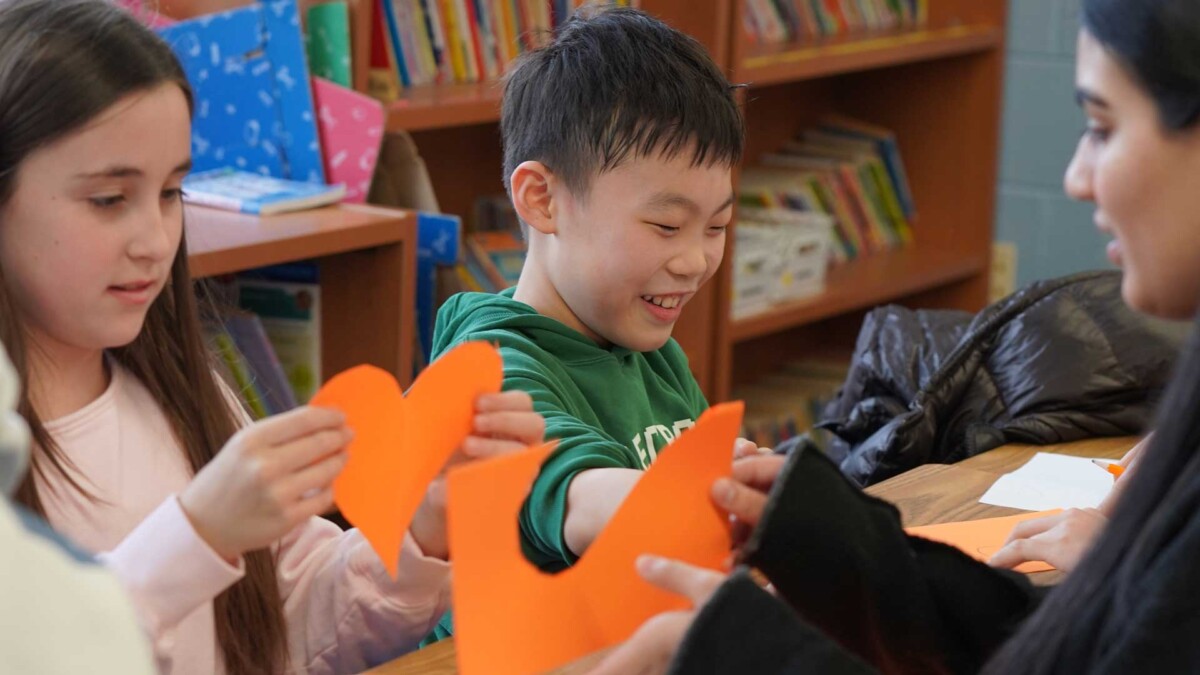
This year’s problem focused on symmetry and consisted of solving puzzles at varying levels of difficulty for each grade level. “It had to do with abstractly thinking about how one could fold paper and make a single cut but end up with a heart shape,” explained Ms. Barrett. “When we interviewed some of the older kids, they talked about how gratifying it was and how fun it was to be able to work with the little kids.”
Likewise, the experience was memorable for the LS students. “I really liked teaming up with the high schoolers,” said Phineas C. ’35, whose third-grade class partnered with Mr. Fred Fontaine’s Multi-Variable Calculus class of 11th and 12th graders. His classmate, Quinn L. ’35, said she, too, enjoyed working with the US students and making something for her buddy, Student Body President Max Koppelman ’26. Of the problem, Quinn said, “I liked how we had to persevere and we had to try and try again until we got it.”
“Here at D-E, we like to say we are all math people, and I think when we shift the definition of what makes a great mathematician, that really supports this idea that we all can do hard things,” remarked Ms. Park.
Innovation in Action
Mr. Gary Middleton, US Math Teacher, said that in his 26 years teaching at D-E he’s seen many things evolve and change. “But the one thing in the mathematics program I came here for was an emphasis on Applied Mathematics. We learn by making connections to things like science and doing mathematics in the context of the real world.”
“I have the students think strategically to solve the problem, so they have to take a situation and innovate,” said Mr. Middleton. “What do I need to do to create a solution to this new situation that I have in front of me? So in that regard, the philosophy of the program and real-world applications and Applied Mathematics is engendering the innovative thinking that I think students will need to address in the outside world.”
Mr. Joe Iwanski, US Math & Computer Science Teacher, added that at D-E he is teaching some of the top students in mathematics and computing. “One of the best reasons to come here for mathematics, in particular, is that we already have a really rich curriculum. We’ve got a lot of courses here that you’re not going to see in most high schools—things like Linear Algebra and Multivariable Calculus and Data Science,” he said.
Developing new courses is also a part of this innovative component. “Like in my Nonlinear Dynamics class, we’re essentially using the computer as a tool to explore these really interesting mathematical, for lack of a better word, creatures that you can see by writing programs,” explained Mr. Iwanski.
Students immersed in these classes also see the advantage of these opportunities. “The math curriculum at D-E is definitely one of my favorite things about the school,” said Ananya. “I’ve been able to take college-level classes like Complex Analysis and Abstract Algebra, which are really unique offerings for a high school curriculum.”
“In the advanced courses I’ve taken, I’ve been able to dive deep into the ‘why’ behind things, which is really important to me,” said Ananya. “For example, in Mr. Fontaine’s Linear Algebra class, I worked with a partner over multiple months to create a presentation that used Linear Algebra concepts to prove why it’s impossible to perfectly comb a sphere.”
Robotics is also core to D-E’s Math and Computer Science programming, starting in the Lower School. LS and MS Robotics students have the opportunity to compete in regional, national, and international FIRST LEGO League competitions, which can segue into competing in Robotics FIRST Tech Challenges for high school students.
Every year the US Robotics Team builds a new robot for a new engineering challenge. “Our students program the robot using the Java programming language,” said US Robotics Coach Chris Fleischl. “Part of the challenge is both controlling the robot’s operations, where a driver can interact with it wirelessly with a controller, but the students also spend a lot of time incorporating sensors and autonomous programming designs so the robot can move and score autonomously during parts of the match.”
“Concepts that the students are learning in their Math and Physics classes are really fundamental to modeling the control systems that the students are programming and incorporating into their robot designs,” explained Mr. Fleischl.
Inclusive Excellence
Of the Department philosophy, Dr. Inna Tokar, US Math Teacher, shared: “You really teach how to approach something, how to understand something, how to develop their thinking, how to struggle. We put a huge value on our students’ ability to struggle and to overcome that, and then reflect back and say, ‘I’m now stronger.’”
“And sometimes I say to a student, ‘I’m really grateful that you made that mistake.’ There’s nothing wrong with that. It’s how you deal with that, and that’s really a very important lesson for them,” said Dr. Tokar.
Ms. Julia Tazelaar, MS Math and Science Teacher, expressed similar sentiments, noting: “The math classroom is a space for anyone. Even if they don’t feel the most confident, if math is not their favorite subject, it is a space where their ideas are valued and there’s a path for improvement and growth.”
Ms. Barrett, who has advised US students in the Women in STEM Education (WISE) club, said it’s also important to expose students to female leaders in math, science, computer science, and engineering. “I think that fosters, from the LS up through the US, a sense of belonging,” she said. “And perhaps their mindset changes about who does math and what the people who do math look like.”