
Tapping Into Our Shared Humanity
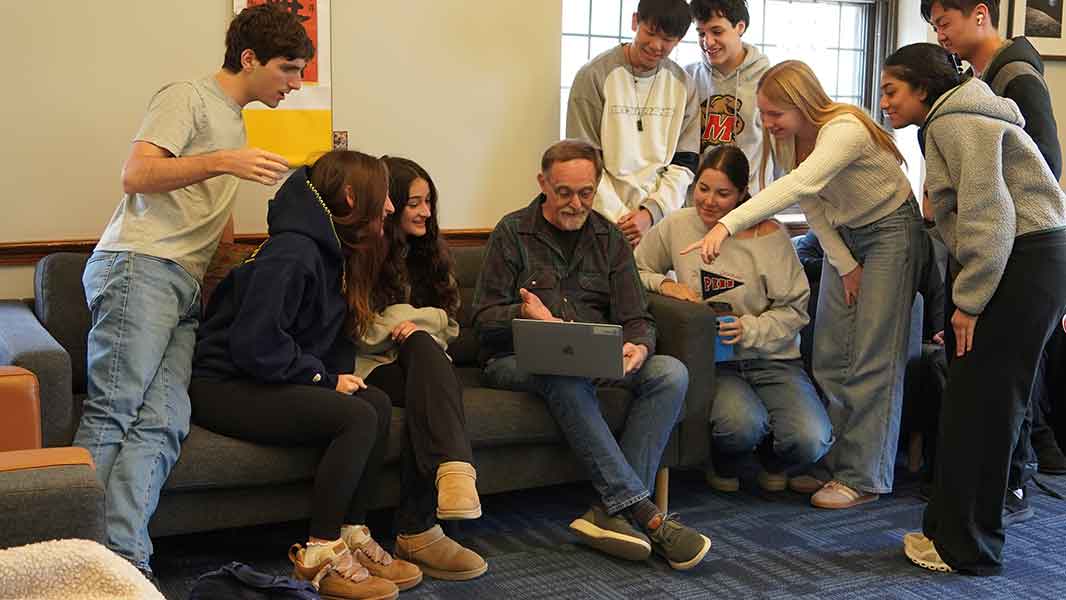
“Ethical thinking is something that all of us as human beings need desperately,” declared Philosophy and Ethics Department Chair Mr. Joseph Murphy, who has spent the past 31 years at D-E. The department he leads is the focus of our next community “Spotlight.”
Last year Mr. Murphy was voted as a member of the International Federation of Philosophical Societies (FISP) as the only high school Philosophy Teacher who has ever been voted onto this prestigious global committee.
“There are major philosophers from around the world who make up the steering committee, and we prepare for the World Congress of Philosophy [with the next session taking place in Tokyo in 2028],” said Mr. Murphy. “This not only gives me a rich understanding of who our students and faculty are right here, but also how I can carry this out into other areas of the world and then reflect them back to Dwight-Englewood.”
Innovation In Action
D-E is exceptional in that we look to tradition when it comes to treating Ethics and Philosophy as the academic subjects they are rather than solely elective courses, as is often the case in many other high schools across the country. “At Dwight-Englewood, we are highly innovative with a very traditional way of academic thinking,” said Mr. Murphy.
“Philosophy and mathematics are the mother and father of academic programs in the world, and it’s curious that in the United States, we don’t teach it in high school as a serious subject,” Mr. Murphy remarked.
“I just wrote an article for FISP, in which I talked about being an invisible philosopher,” said Mr. Murphy. “Invisible because I was a Spanish teacher, but I had a degree in Philosophy. I wanted to teach Philosophy here [at D-E] and Ethics because I thought it was very important for students. So when I started to do it, it became something that was coming out of hiding, in a way.”
“But at the same time,” added Mr. Murphy, “I claimed in this article that we do teach Philosophy and Ethics in the United States by talking about critical thinking and about ethics in all kinds of areas—about caring for other people, about having the principle of impartiality, where people consider each other to be totally equal, which should be the case.”
At D-E, major areas in ethics and moral philosophy have been incorporated in the Upper School (US) curriculum for the past 20 years, so students, beginning in 10th grade with the Ethical Thinking course, are immersed in a variety of philosophical concepts. Juniors and seniors can also register for classes such as Introduction to Philosophical Thinking and Ancient Philosophy, an Honors course that is actually taught in Spanish. New this year is studying the philosophical investigations of British philosopher Ludwig Wittgenstein. “It is very interesting for a high school student to be studying Wittgenstein,” noted Mr. Murphy.
In addition to his roles as Department Chair and Teacher, Mr. Murphy advises the Philosophy Club and Ethics Bowl Team in the Upper School, which provides students the opportunity to discuss these topics with people outside of D-E.
“The exposure to philosophical thinking through Mr. Murphy’s Ethics class introduced me to a discipline I wanted to further pursue, which I did through the Philosophy Club,” said student leader Stefan Popa-Bratu ’26.
“Fundamentally, philosophy is the act of questioning the nature of the human experience, and the study of Philosophy is organizing and bringing theory to this basic element of human nature,” noted Stefan. “Through the Philosophy Club, we have bridged the gap between this organized and disorganized philosophical inquiry.”
Stefan recalled that in Mr. Murphy’s Modern Philosophy in Spanish class, students read and discussed René Descartes’ Meditations on First Philosophy, in which Descartes posits his famous quote, “Cogito, ergo sum,” which translates to “I think, therefore I am.”
Stefan said Mr. Murphy was able to change his initial perception that the ideas of Descartes were “somehow elementary.” He added, “I think [Mr. Murphy] was able to really well present the elegance of Descartes’ ontology as well as the nature of Descartes’ work in the broader context of the development of deism from scholastic thinking.”
Inclusive Excellence
The subjects of Ethics and Philosophy also represent inclusive excellence because “you can’t think about ethics without considering who we are as people and how we should treat each other… diversity and inclusion are very important because human beings need to understand how they are similar to everybody else and different from everybody else and learn how to enjoy what that difference is,” said Mr. Murphy.
“We ask philosophical and ethical questions, framed by ethical theories that lead back to the time of Aristotle, for example, with virtue ethics,” said Mr. Murphy. “It’s a 3,000-year-old tradition. The Judeo-Christian system also has systems of thinking like this… and there are more modern systems, like the ethics of care, which developed in the middle of the 20th century.”
Mr. Murphy added that we are programmed to question who we are. “And so learning who we are and talking about how we need to treat each other here at school is preparing [students] to treat each other well beyond these four walls of Dwight-Englewood, through college and into their professional and family lives,” he said.
In terms of his goals for the department, Mr. Murphy said they include facilitating opportunities for the Upper School to work with the Lower School (LS) in a program called Puppet Philosophy, in which teachers use stories and puppets to discuss philosophical and ethical issues with our youngest students.
Mr. Murphy said he also hoped to re-establish an Ethics Bowl team in the Middle School (MS), as one was active several years ago at D-E. Creating a MS Ethical Thinking program would allow for continuity from LS Puppet Philosophy through the Upper School.
Of the US Ethics Bowl, student leader Hannah Chun ’27 said she was “initially drawn to the organization because I always loved pondering impossible life scenarios, whether that be in a medical setting with saving, losing, or creating life, or in family rights versus duties, with no obvious right answer.”
Through her participation in Ethics Bowl, Hannah said she appreciated having “a place where I could talk about my thoughts, get to listen to new perspectives, and discuss a common interest.” The experience, she added, “has bled into my life to handle situations in my personal life with different ethical theories.”
Hannah noted that as Faculty Advisor, “Mr. Murphy doesn’t give us answers, but teaches us how to ask better, more precise questions.”
Whole-Souled Citizens
Mr. Murphy said each year he welcomes the fresh perspectives that the 10th graders in his Ethical Thinking course have to offer. “Every time I talk about something, they have a new take on it.” He also noted he has observed some overlap with ethical thinking in History, English, Physics, and other subjects.
“I talk about Physics a lot in the Ethical Thinking course, which might sound odd to people, but Physics used to be a branch of Philosophy—Natural Philosophy. There is great speculation in wonder about the whole universe.”
This viewpoint aligns well with the School’s enduring aim of fostering whole-souled citizens. Mr. Murphy said he often talks about teaching the whole student. “I like the idea of a whole-souled citizen because the soul is the essence of a human being,” he remarked.
“Whether you believe in a soul or not is irrelevant,” he said. “It’s the tenderness and the care that we need as human beings and who we are essentially as human beings. And then, at the same time, to be citizens, not only in the school, but citizens of the nation and citizens of the world… We need to reach beyond ourselves in a certain sense… for the benefit not only of the wider world, but for the benefit of ourselves living in that wider world.”
Several of Mr. Murphy’s students have come to similar conclusions. “D-E encourages students to become whole-souled citizens by helping them develop empathy, self-awareness, and genuine engagement with the world around them,” observed Hannah. “This exposure changes how you think beyond the classroom… you begin to reflect more carefully on your reasoning behind your choices and how they affect others.”
According to Stefan, being a whole-souled citizen is largely the state of being a thoughtful member of society. “Thinking critically, which is the primary skill developed by studying philosophy, is a precursor to being a whole-souled citizen,” said Stefan.
“Frankly, I love what I do,” said Mr. Murphy. “I have the opportunity as a philosopher to do my work with something I love, with students who are always creative and innovative in so many ways… and to talk about this with other faculty members.”
“I hope that [my students] walk out of here with a greater sense of who they are and a greater sense of the obligation that we have for each other. And in some sense, I say to the students, what you’re learning in this classroom will be relevant to you in 10 and 20 years… when in your professional or personal lives a problem comes up and you understand that problem to be a moral question… and my hope is that you’ll be able to deal with it a little bit better.”