

In continuation of a monthly series spotlighting D-E’s community of learners in every department, we had conversations with English Department Chair Mr. Jeremy Meserole, P’26, ’28, ’30, and other English Department faculty, who spoke on topics such as being inclusive, self-discovery, and innovation in action in the curriculum.
We also highlight projects like the cross-divisional “Small Stories” exploration the Creative Writing class of Ms. Stephanie “Tuc” Tucker, Dean of the Class of 2027, recently completed—a partnership between the Upper School (US) and Lower School (LS)—our biannual Write Night, and the Poetry Connections sessions in the Middle School (MS). Read on to learn more about our inspiring English Department at D-E!
Inclusive Excellence
According to Mr. Meserole, the English Department has worked hard, especially within the 9th and 10th grade programs as well as in the Middle School, to curate a diversity of voices for students to read that are relevant to them across genre, demographics, personalities, and identities.
Teachers in the department, he added, “create the conditions for learning… and if you create the conditions for learning in the classroom… students feel naturally empowered, and they want to find relevance to what they’re reading and they want to find connection.”
“Our curriculum is designed to be inclusive, to celebrate many voices—not just historically, but voices within the canon,” said Mr. Meserole.
Ms. Amanda Burnett, 8th Grade English Teacher, whose class studied The House on Mango Street, by Sandra Cisneros, presented an example of this alignment in the Middle School. During the study of the text, “students investigate how elements like names, language, and gender roles act as both personal anchors and social constraints,” explained Ms. Burnett. “The unit implicitly reinforces that their identities are valid, complex, and worthy of exploration, fostering a classroom community where diverse experiences are seen as essential to our collective understanding.”
Similarly, Ms. Meredith “Mimi” Garcia, US English Teacher, said her classes are about “understanding what it means to be human… and having tough conversations.”
“We set those conversations in a context of a fictional universe like [Shakespeare’s] Macbeth, like Purple Hibiscus [a novel by Nigerian writer Chimamanda Ngozi Adichie], which deals with race, family dynamics, and socioeconomic dynamics,” said Ms. Garcia. “At the end of the day, I’m interested in kids seeing themselves… but also seeing the world from multiple perspectives because, like our mission states, if we are going to meet the challenges of a changing world, we’ve got to know the world… and the different people that live in it.”
Self-Discovery
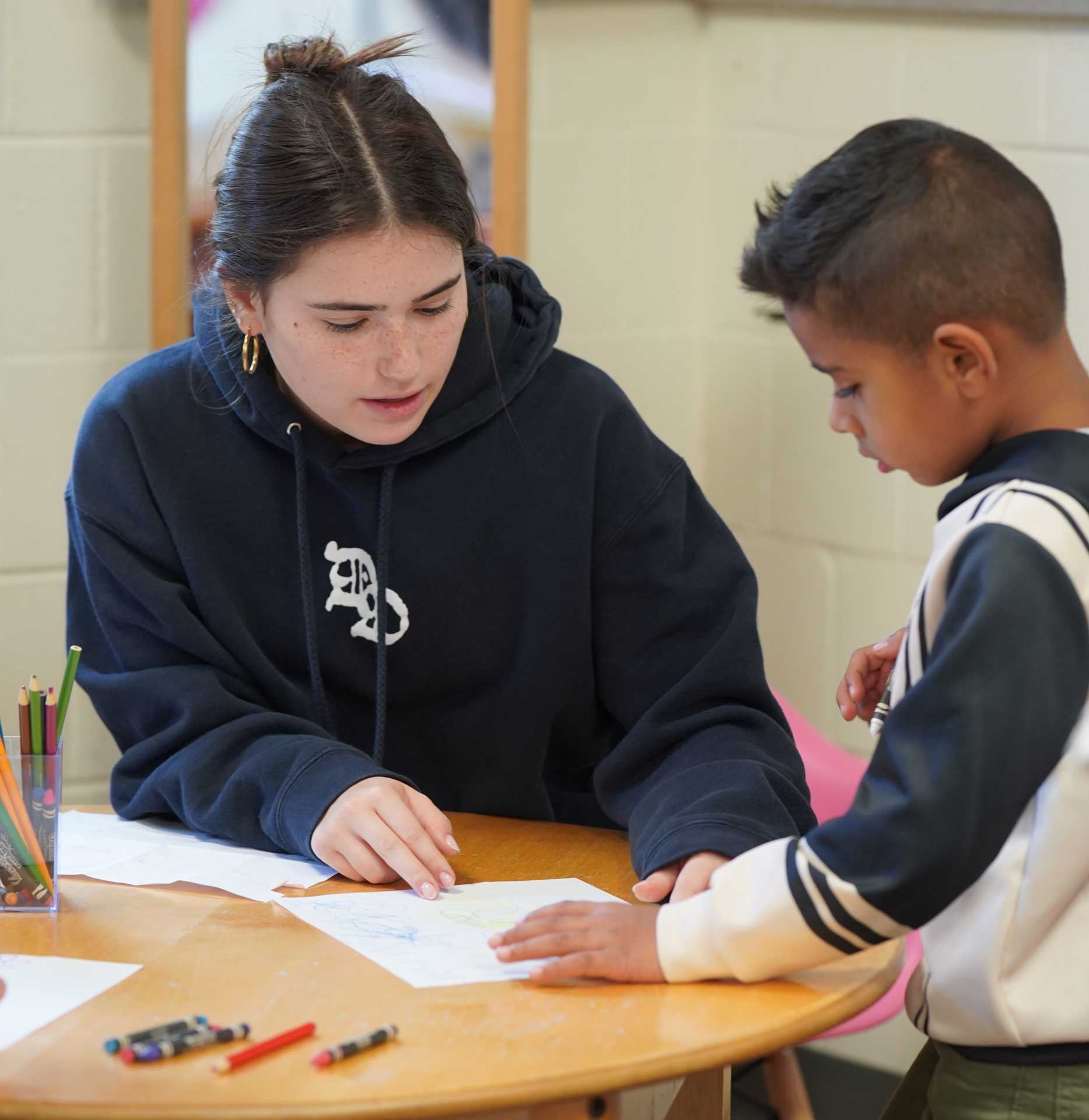


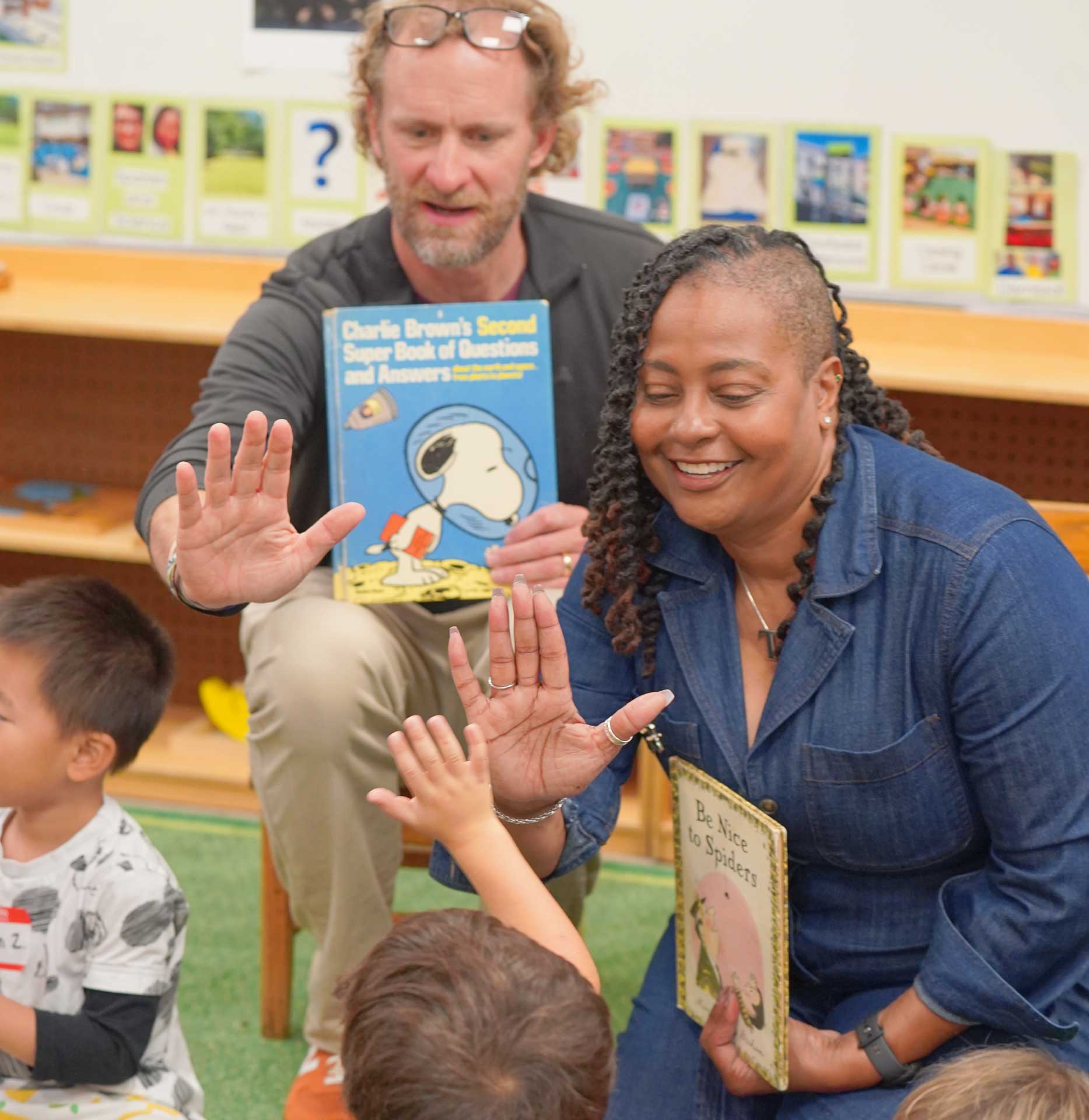
Seeing the world from a different perspective also enables our students to self-reflect when they are composing written work. “We want you to pull ideas from other places and put them together in creative and novel ways,” said Dean Tuc. “And I think that when you’re creating something that is new, that is representing who you are as a person… it’s really liberating.”
US students in Dean Tuc’s Creative Writing class recently partnered with the PreK 4 Class of 2039 for a cross-divisional book project. The semester-long project culminated with the completion of “Small Stories,” created in collaboration between these “big” and “small” writers.
In the process, several D-E Lifers, including Senior Lily Berger ’26, had the unique experience of recalling their own time in Drapkin Hall’s PreK classrooms. Lily described the project as “a memorable experience and a creative way to investigate the world of creative writing.” And she said she looked forward to sharing their final book “as one of my lasting impacts here [at D-E].”
Another D-E Lifer, Chloe Yoon ’26, got a chance to share her own self-published children’s book, titled Beautiful Scar, during a storytime with the PreK 4 class. Chloe’s book began as a memoir draft she wrote in English class and refined for her 10th-grade portfolio.
“As her teacher that semester, I witnessed her thoughtful process of revising a deeply personal story, and it has been a joy to see it evolve into a published children’s book,” said Dean Tuc.
It was Chloe’s idea to incorporate her story into the “Small Stories” lesson. “When I was at the Lower School, I wouldn’t have even imagined publishing a book, let alone reading it to a class,” said Chloe. “My book was inspired by my childhood and I wanted to share my story with children and encourage them through any hardship they may be going through.”
Added Tuc, “By showing and reading her book to [the PreK 4 class], Chloe is reinforcing the idea of this joint project—that writing and telling stories is for everyone.”
The department more broadly presents opportunities for students to share what they’ve written either in class as part of an assignment or what they’ve penned outside the classroom. One such opportunity is the biannual Write Night, which was started 14 years ago by US English Department Faculty Mr. Fred Daly and is now organized by Ms. Lisa Quirk, US English Teacher.
“Write Night, in and of itself, is meant to celebrate the spoken word,” said Mr. Meserole, adding that in addition to students across grades, faculty and staff are also welcome to read.
“So it’s really meant to be an inclusive act of community building around the written word and spoken word.”
The longstanding US event inspired a similar twice-yearly event in the Middle School called Poetry Connections, created after MS faculty got together to figure out a way to increase engagement in poetry sharing, explained Ms. Pooja Patel, 7th Grade English/History Teacher. “We prepared two different poetry units, one at the beginning of the year where [students] share who they are, and then one at the end of the year, where they reflect on their year and they write an ode to the year,” said Ms. Patel.
“I hope that every student, as they go through the 6 through 12 experience, and in the English curriculum in particular, they see themselves in one capacity or another, and they see themselves fitting into a broader community,” remarked Mr. Meserole.
Added Dean Tuc: “It’s really important that we are one school and we have the opportunity to see each other and interact with each other and work together… And that’s really what this is about—it speaks to our mission of being one school, of being lifelong learners.”
“Kids have to look inside themselves, see what their strengths are, what they have to work on, and then they have to connect it to what they see in the world and see what they can offer the world,” said Ms. Patel. “So, our curriculum allows them a safe space to explore who they are and then to learn about what the world has to offer.”
Mr. Stephen Bailey, US English Teacher, concurred that self-awareness is a critical component. “[It is asking yourself] how do I apply that [understanding] to the community we’re trying to build? And when I say community, I mean not just the Dwight-Englewood community, I mean the little community of our classroom… Do they find ways to bring their colleagues, their peers into the conversation?”
Innovation In Action
The English Department offers an US course called Writing in the Age of AI, developed last year by Ms. Zahra Mamdani, US English Teacher, and currently taught by Mr. Meserole. He said the class teaches students how to integrate into our curriculum in a creative and innovative way the Artificial Intelligence (AI) technology that is increasingly impacting all aspects of our lives. Specifically, students use Gemini, part of Google Workspace and one of D-E’s approved AI tools for students, to assist in writing and research assignments.
Mr. Meserole admitted he had some initial trepidation about teaching the class, as he has a traditional mindset when it comes to writing. “But I think I’ve learned a lot about how AI can be a tool to help students learn better and to write better,” he said.
On AI, Ms. Meredith “Mimi” Garcia, US English Teacher, remarked, “We’re a little scared of it, right?... Because we teach writing. But, it’s going to be part of our future. We’re going to have to learn how to meet that challenge and have a better understanding of what it means in our classroom.”
Beyond the use of technology itself, our English Department faculty use innovative approaches to pedagogy.
“I foster innovation by designing projects that reward creative synthesis over simple recall,” said Ms. Burnett. As a prime example, she pointed to the “Sounds of Mango Street” end-of-unit project that she co-designed with Mr. Gautham Akula, 8th Grade English/History Teacher, for which students not only analyze the text, but also curate a playlist for it. They also defend their song choice by drawing parallels in theme, diction, and figurative language between a vignette and their selected track.
“This task will require them to take the intellectual risk of making personal, sometimes unconventional, connections,” said Ms. Burnett.
“The work of merging literary and musical analysis celebrates students’ diverse perspectives and will result in a shared, innovative artifact—a class soundtrack that reinterprets the novel through a collaborative and creative lens.”
Innovative thinking can also take the form of challenging MS students to fight the dissonance that reading and writing can present, explained Ms. Patel. “We actually ask kids to acknowledge their negative self-talk and say, it’s okay to think that things are hard, that we can’t do them, but then learn the strategies and be really thoughtful and demonstrative about using positive self-talk to shift that thinking,” she said.
“We encourage failure because successful writing only happens when we fail, and when we see how we fail, and then reflect on what’s happening to make it better,” said Ms. Patel. “So we celebrate failures. We celebrate mistakes. We celebrate reflecting and growing.”
Mr. Bailey shared: “I think innovation can be repurposing tried-and-true methods to meet the students where they are, and to take things that we know are effective and always have been… and fine-tune them so that it meets their needs.”
Whole-Souled Citizens
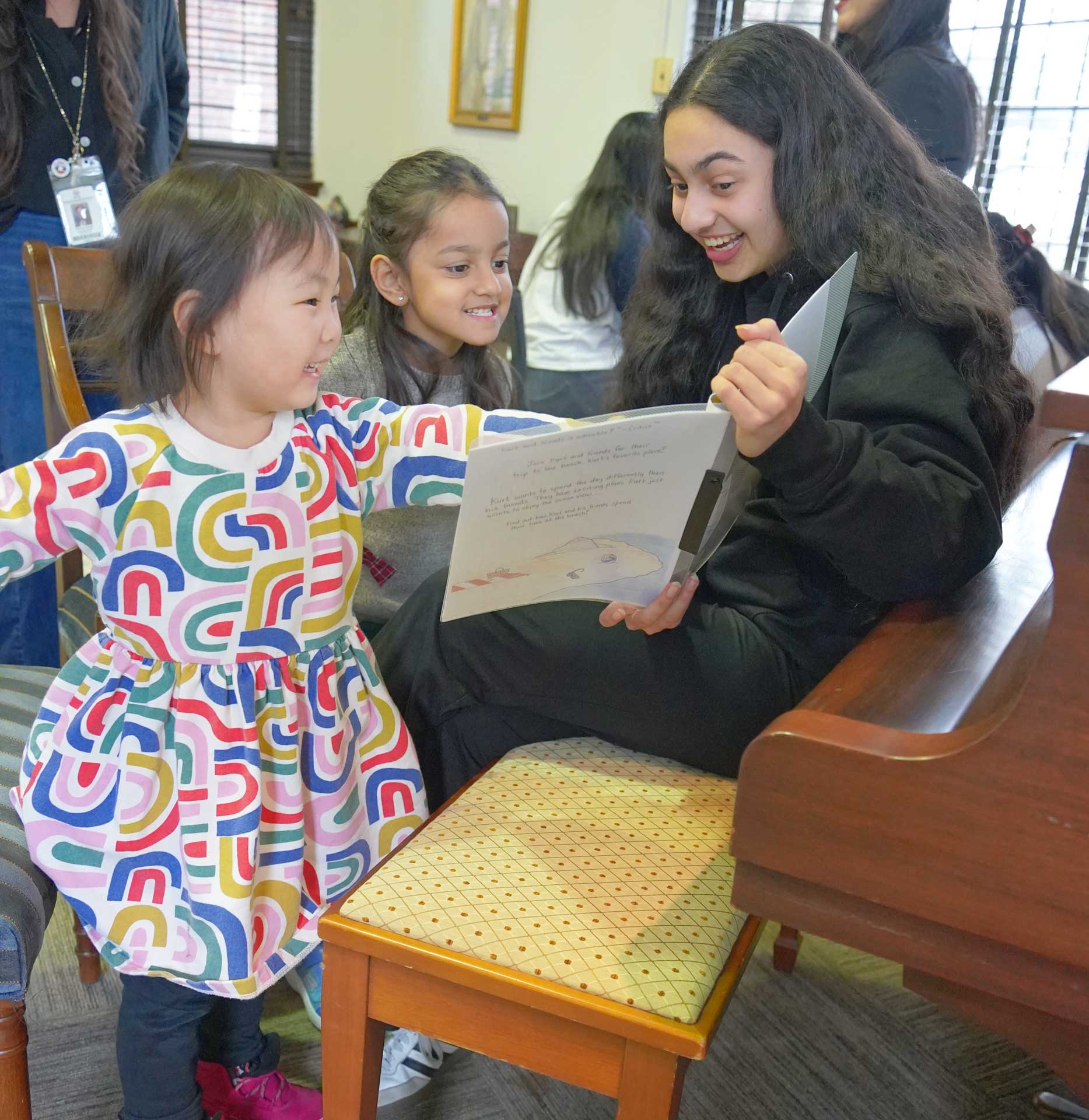
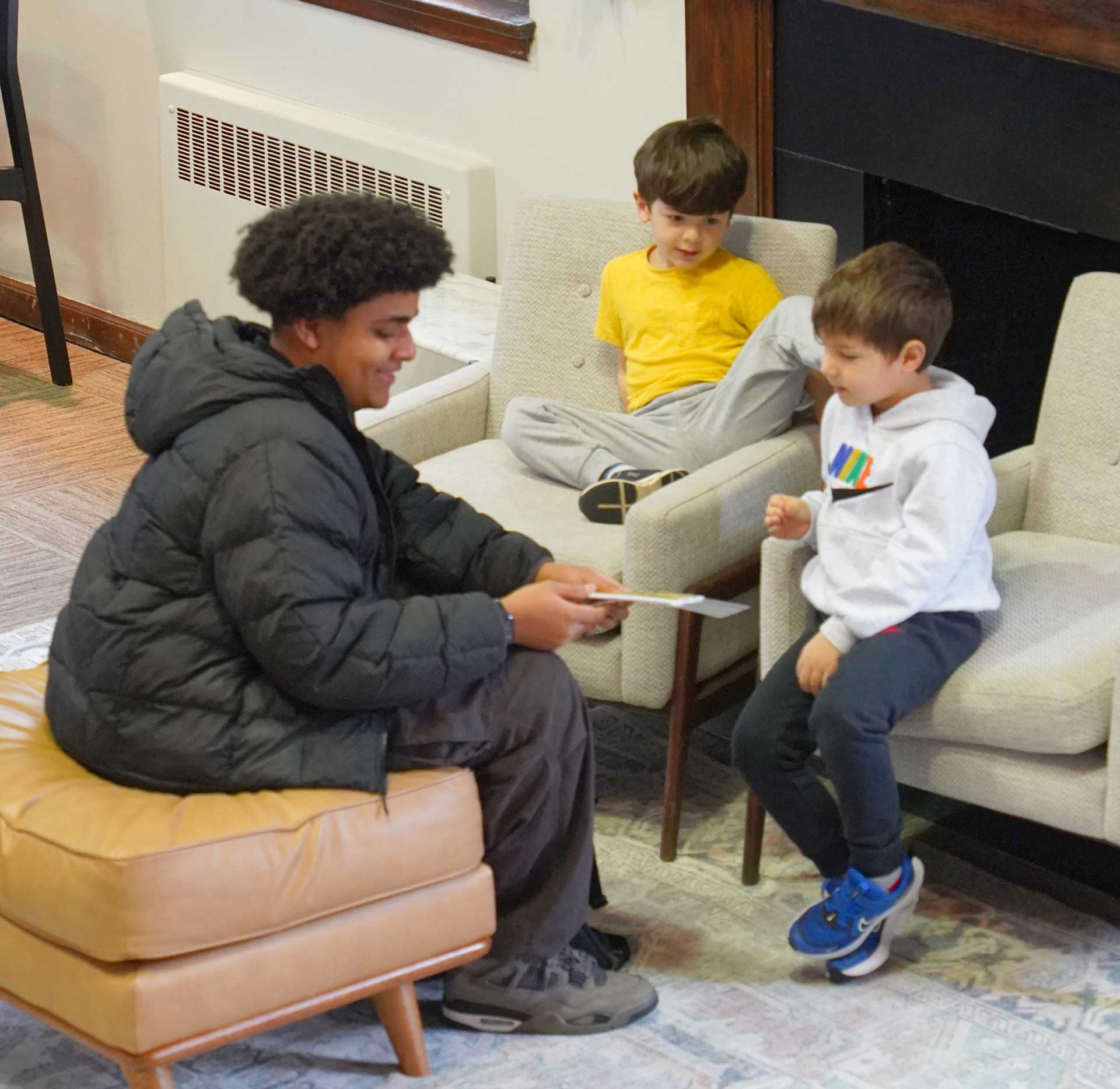
Much like the English Department is committed to creating an environment of inclusion and belonging, noted Mr. Meserole, English teachers are also encouraging the development of whole-souled citizens, as described in D-E’s Strategic Plan.
“Everything we do in the classroom discussion is about developing the whole child and in alignment with the mission to change the world and make it better,” said Mr. Meserole.
“[Our educators] center their students first and foremost in everything they do, and they want their students to leave the classroom—whether it’s literally that day… or they graduate and go across the commencement stage—feeling like what they’ve studied and what they discussed and what they’ve written about… is about being a better person and about being a better citizen.”
In Ms. Burnett’s view: “Being a ‘whole-souled citizen’ implies that academics are not the sole defining feature of being a D-E student.” She added, “I believe that the English Department takes pride in fostering whole-souled citizens through explorations of texts that prompt meaningful discussions about societal responsibilities and each person’s capacity to fulfill them.”
“I think the way the English Department encourages students to become whole-souled citizens is by the passion we bring to our subject matter, by the choice of literature we bring into the classroom,” said Mr. Bailey.
“We’re very thoughtful and careful and deliberative and conscientious about the literature that we offer up to them, so that… they can see themselves in some ways, or discover something about their humanity in the literature they’re reading… that enriches their souls, and we desperately need that in the world right now.”