
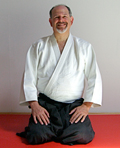
Laurin Herr’s update,
“Born and raised in New Jersey, I began my martial arts training in 1971 at Cornell University by taking up Judo to fulfill my compulsory physical education requirements for graduation. After a few months learning Judo basics, a visiting Japanese graduate student started to lead a small informal Aikido class in a corner of the same mat room.
From the first moment I saw Aikido, I found beauty in the fluid blending movements. I was impressed by the effortlessly powerful throws that sent people flying only to have them roll back up to their feet for more. And I was attracted to its non-violent, non-competitive philosophy. My first instructor at Cornell, Katsuhide Kusahara, 4th dan, made Aikido look elegant and easy, but I felt awkward and the techniques were difficult for me to perform. Rather than be discouraged, I was hooked, inspired to discover the heart of Aikido at its source, in Japan.
I began studying Japanese art and culture, history and politics. I managed to be get myself admitted to Cornell’s new full-year Asian language concentration (FALCON) program as a graduate student, plunging into intense Japanese language training for 14 months. By 1973 I was living in Tokyo. I entered Hombu Dojo as an unranked white belt, taking daily classes under Kisshomaru Ueshiba Doshu and senior Hombu instructors Kisaburo Osawa, Seigo Yamaguchi and Mitsugi Saotome. I received my Shodan at Hombu Dojo in 1976.
On a trip back to the USA in early 1976, I happened to walk down Bond Street in New York City. Attracted by what seemed to be the thumping sounds of ukemi drifting out to the street, I stepped through a dark doorway to meet Terry Dobson and Ken Nisson, co-founders of the Bond Street Dojo, thereby starting another important thread of my Aikido practice that continued for years to come.
I returned to Tokyo to pursue my graduate studies in anthropology and international relations at Sophia University and my Aikido practice at Hombu Dojo. But in 1977, I decided to move to the small town of Shingu on the remote Kii Peninsula to immerse myself in Aikido more deeply by training full time under Hikitsuchi Michio, 10th dan, and senior instructors of the Kumano Juku Dojo, especially Motomichi Anno 7th dan and Motokazu Yanase 6th dan.
My time in Shingu was intense, challenging, fantastic, and formative — a life-changing adventure of vigorous keiko (physical training) twice daily and nearly constant shugyo (spiritual training) that permeated everything. Even when I was not physically residing in Shingu, my shugyo under Hikitsuchi-sensei did not stop. For example, my training included planning and organizing a 55-day 12-city teaching tour of America by Hikitsuchi-sensei, Isogai Shohei (Osensei’s friend and seal maker) and six other teachers and students from the Kumano Juku Dojo. I received my 2nd dan as part of the Shinto ceremony marking the 10th Anniversary of Osensei’s passing held on the stage of the Japan Society of New York in 1978.
Afterwards, I settled in New York City, met my future wife, Trisha Gorman, on the subway commuting to Aikido practice, and founded my own consulting company, Pacific Interface. I traveled frequently between America and Japan on business throughout the ‘80’s as I continued practicing Aikido at the Kumano Juku Dojo in Shingu, and at the Bond Street Dojo in New York. I also worked on translating and publishing the
English-language version of Hikitsuchi-sensei’s first video tape, Heart of Aikido. I was promoted to 4rd dan in 1990.
In 1992, I moved from New York City to Oakland, California to work for a fast-growing computer peripheral company pioneering digital media technology. Over the next 12 years, I threw myself into my career at four successive Silicon Valley companies, which continued to take me to Japan and to other countries in the Asia Pacific region and to Europe, but which left me little time for regular Aikido classes.
During weekends and vacations, as my job permitted, I worked on editing and translating a new three-volume video by Hikitsuchi-sensei, titled Essential Teachings of Aikido. Shot in Shingu and at the nearby Nachi waterfall in 1992, this aspect of my shugyo was finally completed in 2000 with the help and support of friends, family and fellow Aikidoists. I was promoted to 5th dan in 2000.
In late 1998, I met Robert Nadeau, 7th dan, and soon started practicing regularly with him at Aikido of Mountain View even as I maintained an active relationship with Hikitsuchi-sensei until his passing in early 2003. In 2004, I joined Nadeau-sensei at City Aikido of San Francisco and started teaching classes there regularly in early 2005.
I have come to understand Aikido as a way of life that can change one’s destiny. It has certainly changed mine. Teaching at City Aikido of San Francisco is a challenging new phase in my personal practice, leading me to search for ways to convey the true essence of Aikido as taught to me by so many remarkable teachers who themselves were passing down lessons they received directly from Morihei Ueshiba Osensei, the Founder of Aikido.
My most Memorable Aikido Experience
My most memorable Aikido experience happened while I was a shodan training under Hikitsuchi-sensei in Japan. It’s a two part story.
The first part took place during a public demonstration at the Kumano Shrine in Yamaguchi Prefecture in Japan, one of the branches of the Kumano Hongu Taisha to which Osensei made so many pilgrimages. Students and teachers from the Kumano Juku Dojo in Shingu traveled to this shrine every year to help them celebrate their annual Spring festival. A plywood stage covered with thin straw mats was erected for the outdoor Aikido demonstrations with festival-goers crowded around the edges. The demonstration started with the lowest ranked students, followed by more senior students, followed by teachers, with Hikitsuchi-sensei giving the culminating lecture/demonstration. As was his custom, he never said in advance what techniques he planned to show or whom he would call-out to be his uke. As the demonstration went on, I lined-up with the other blackbelts, seated in seiza, poised to jump up if called, but not expecting to be since I was just a shodan. Suddenly, I heard Hikitsuchi-sensei call my name and saw he wanted a one-hand grab attack. I rushed in to grab his wrist as fast as I could. But before I even reached him, I heard a terrific, piercing shout. The next thing I knew, I was hitting the plywood six or seven feet away. I had no sense of what had just happened, but afterwards people told me I had flown nearly horizontally across stage. This was my first time to be on the receiving end of Hikitsuchi-sensei’s kiai. I felt cracked-open, mystified at why I had no memory of the time or space between my attack and my landing.
The second part took place a few months later during an evening class at the Kumano Juku Dojo in the oppressive heat and humidity of mid-summer Shingu. Hikitsuchi-sensei had been driving everyone in the dojo for weeks to lift the intensity of our practice so we could learn “true Aikido.” This night was no different. After an hour of vigorous pairs-practice that had everyone sweating profusely, he broke the class into two groups, each led by a senior instructor. Students stood in a circle forming a ring, with the instructor in the center. One after the other, the instructor would call out a student to be uke, continuously throwing them as fast as they could stand-up until they were out of breath, at which point the student would step back to the outer circle and the next student would step in. When it came my turn, I attacked full speed again and again. Then, just when I felt I was running out of steam and ready to stop, I heard Hikitsuchi-sensei’s voice crack like a whip inside my head. “Go faster, Laurin, faster,” he shouted in Japanese. And from some hidden reservoir I didn’t know I had, I found the energy to accelerate my attacks until I heard Hikitsuchi-sensei’s command to end the class. I was completely and utterly spent. After bowing-out and folding my hakama and keiko gi, I went across the street to the public baths and sat naked on my bath stool, dazed, just pouring bucket after bucket of water over my head trying to cool down. In the days that immediately followed, I felt something inside me had changed. My Aikido technique did not suddenly improve, but I felt like I was standing up a little straighter and breathing a bit deeper. I noticed that I was able to sit seiza longer and more calmly. I was more patient waiting for people. I was more polite and more grateful for small favors. I was more fully focused on whatever I was doing.
These experiences taught me, in a most direct and personal way, that Aikido is a way to transcend ourselves, to move beyond our self-image of who we are and what we are capable of doing. Being instantaneously thrown by Hikitsuchi-sensei’s kiai with “a speed that transcends time and space” challenged my fundamental assumptions about what is and is not within the realm of possibility. Finding the strength and determination within myself to answer Hikitsuchi-sensei’s call to “go faster” that hot summer night in Shingu taught me I can intuitively access unseen sources of vital energy when needed. These are life lessons from Aikido that have changed the way I conduct myself both inside and outside the dojo, lessons I am still digesting even today.”