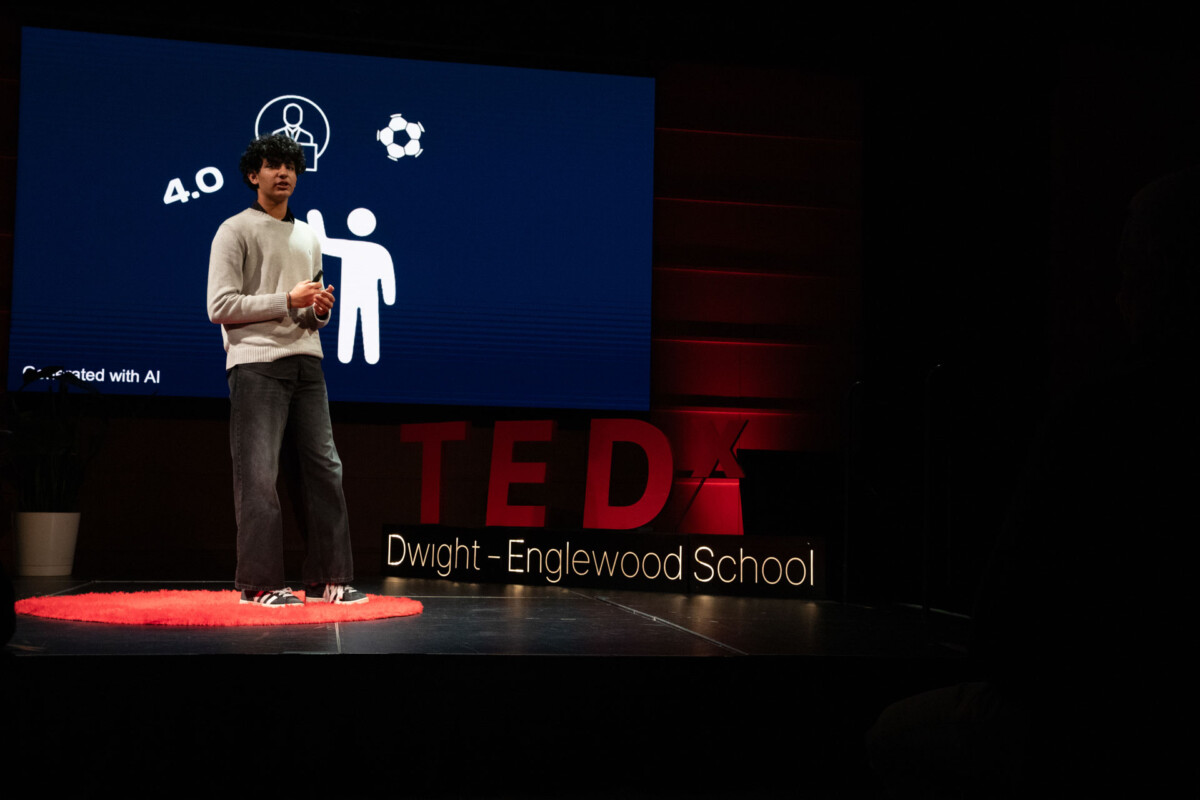

TEDxDwight-Englewood School returned this year with another exceptional lineup of speakers from the Upper School (US) to give a TED Talk on a range of thought-provoking topics. The goal of this year’s talks was to tie their central points to the human experience. The event was facilitated by Chief Innovation Officer Diana Gross and co-produced by Anna Ibargüen ’26, Krishnav Tapuriah ’26, and Madigan Kacmar ’26. They were assisted by associate producers Sylvie Yao ’27 and Jared Mosseri ’27. In addition, each speaker was mentored by D-E faculty and staff, including Dean of College Counseling Eileen Cunningham Feikens P’14, P’15; Human Development Chair Dr. Daniel Carragher P’26; US History Teacher Peter Waltman; US Science Teacher Petra van’t Slot; US Science Teacher Scott Murphy; and Grade 8 English Teacher Amanda Burnett.
By creating a space for original thought and personal insight, TEDxDwight-Englewood School enables students to contribute to an ongoing, reflective conversation within our community about what it means to be human. See below to learn more and watch the presentations in full.
Cooper Carragher-Haim – The Illusion of Certainty
Cooper Carragher-Haim ’26 was the opening speaker with a talk inspired by his knowledge of using data to predict where he should go to college and how to build a profitable investment portfolio. As part of a research project, Cooper used machine learning as a tool to see how accurately AI models could predict stock market prices. In the end, he discovered the linear model worked the best to forecast success. “Complexity is not always equal to accuracy,” he surmised. He related this conclusion to the overall human experience, whereas “the simplest, most straight-line solution is often the most effective.” Cooper connected this idea to the illusion of certainty. “You’re always searching for certainty in an uncertain world,” he proposed. “Life isn’t about eliminating uncertainty. It’s about moving forward with enough clarity to deal with the uncertainty when it arises.”
Megan Rhee – Beating the Mental Game
Megan Rhee ’29 followed with a talk on thought control. She described one moment in particular, when while playing in a tennis match she felt disrupted by the action of an opponent who stopped mid-match to tie her shoes. It broke her momentum, caused her distress, and negatively affected her performance. Researching solutions for getting out of her head led Megan to the psychological technique of cognitive restructuring. She learned that doing simple math problems in her head allowed her to get back in the game by distracting her from mental noise. “Whether you’re an athlete, student, friend, sibling, or an adult, these strategies of cognitive restructuring and thought suppression can be applied to any thoughts that need assistance,” she suggested.
Arnav Garg – The Myth of Balance
Next, Arnav Garg ’28 spoke on the struggle to balance multiple interests. “For a long time, I thought perfect balance meant to give everything equal time, equal energy, and equal effort all the time,” he said. Arnav said he felt guilt and a fear of failure when he found himself unable to balance his academics and extracurriculars. “The word ‘perfect’ itself is imperfect,” he reasoned. He referred to studies on striving for balance, one of which concluded that “guilt resides in the middle of the burnout process” and leads to exhaustion. He used the analogy of trying to fit sand, pebbles, and rocks into a jar—the best fit being starting with the rocks, then the pebbles, and finally the sand. “Once you understand what truly matters to you, you need to prioritize that, and put that in your jar first,” he said.
Kylie Karageozian – Are You Really Immune to Evil?
The presentation by Kylie Karageozian ’27 explored The Lucifer Effect, coined by psychologist Philip Zimbardo, which is the idea of “ordinary” people committing evil acts. “All of us are shaped by our circumstances, and in the wrong situation our morals can bend further than you think,” she said. Kylie recalled how she first encountered The Lucifer Effect in middle school when an irresistible need to fit in resulted in her taking part in gossip and “backstabbing” behaviors in her friend group. “I had diluted my personality so much that I no longer recognized myself,” she said. “But that awareness was the hardest part, and it was also the first step. It forced me to branch off, rebuild, and find new friends who valued me for who I was and not for my ability to spread a good rumor.” More broadly, Kylie reasoned that The Lucifer Effect can be countered “if we remain aware and brave.”
Jason Lee – Is Analytics Ruining Baseball?
For his talk, Jason Lee ’27 discussed how data analytics has transformed baseball, a sport he said he loves, in a way that has somewhat dehumanized the sport. “The moments that defy logic are the ones that we remember the most,” Jason said. “If you strip randomness, human intuition, and emotional momentum away from the game, you’re not perfecting it… you’re mechanizing it.” He gave examples of other ways we seemingly reduce areas of our lives to numbers—with GPAs, social media followers and likes, insurance risk profiles, and screening algorithms that hiring managers use. He summarized that while analytics can provide helpful information, it should not be the final word. “Use [data] as a tool, rather than a verdict,” he said.
Tyler Pinniger – System Reboot
Tyler Pinniger ’27 rounded out the talks with a personal story about his challenging six-week journey recovering from brain surgery to remove a tumor. He described the experience as a “system reboot” that made him reflect on the important things in life. “My medical story is not defined by my medical history, but rather by what I’ve been given and how it has empowered me to examine who I am and what I value most,” he said, adding that it’s a story of “overcoming insecurity, embracing gratitude, and paying said gratitude forward.” He stressed the importance of giving kindness to others as well as ourselves. “Accepting myself, scar and all, is how I truly found happiness,” he remarked. And a similar mindset shift could be applied to any challenges people face in life.