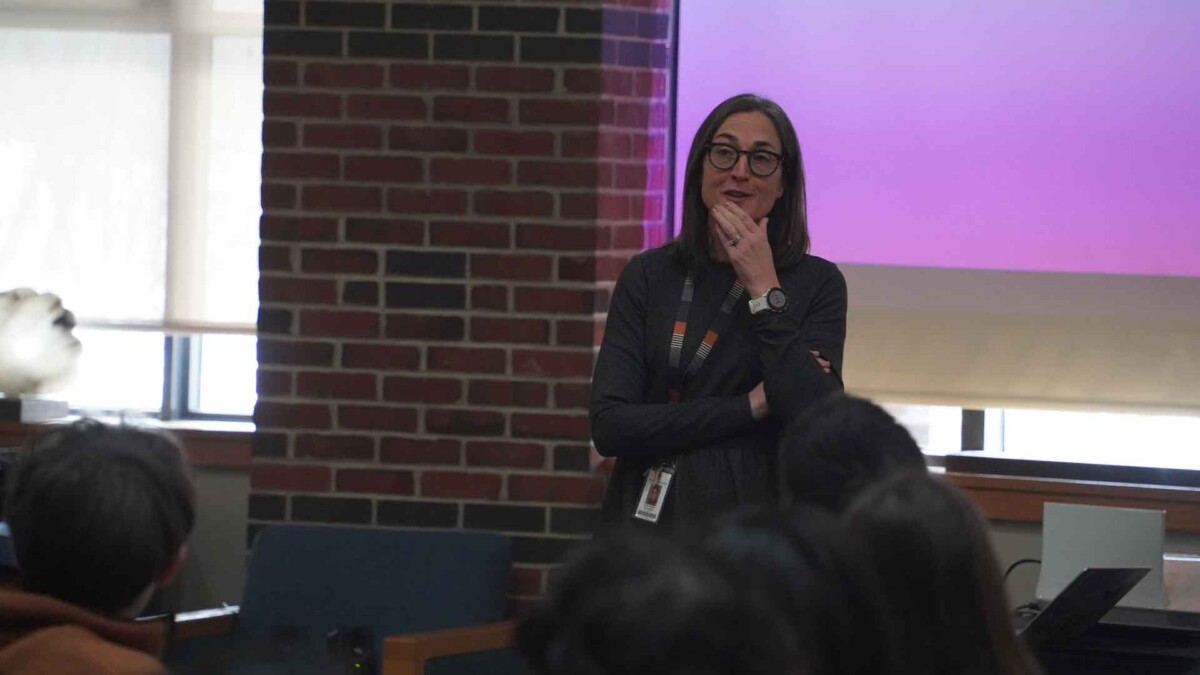

Ms. Emily Sclafani, Dean of the Class of 2026, has been actively involved in helping to develop a strategic plan for D-E that applies, as she wrote last summer, “our founders’ wisdom to the challenges of a changing world.” This work, articulated here, is based on an idea from a founding Co-Principal of the Dwight School on the importance of each student becoming a “real whole-souled citizen.”
Paramount to this mission is engaging in deliberative dialogue across the spectrum of political views. As Faculty Advisor for the D-E Political Discussions (D-EPD) Club, Ms. Sclafani has often discussed how perception gaps have contributed to polarization in the nation and facilitated informational sessions on policies, such as immigration, that have been particularly divisive in the United States.
In addition, Ms. Sclafani published an article titled “Dignity & Discourse” in Independent School magazine (“The Students Issue”), published by the National Association of Independent Schools (NAIS). In the article, Ms. Sclafani reasoned that schools must ensure “dignity safety” (such as guarding against microaggressions) over “intellectual safety” (not considering opposing viewpoints), as the latter stifles critical thinking.
“Helping students develop the social-emotional skills necessary to discern when they are being appropriately challenged… and when they are being humiliated… is vital work,” wrote Ms. Sclafani. Read on for more insights on this work from Ms. Sclafani.
What does it mean to be a “whole-souled citizen” and why is it important to foster these qualities in our students?
The phrase comes from a letter written in the 1880s by Dwight School co-founder Euphemia Creighton to one of the school’s graduates. Creighton’s notion of a “whole-souled citizen” is one who balances serious academic pursuits with many other interests. She wanted Dwight students to pursue their intrinsic curiosity and develop their sense of self through meaningful engagement with the wider world.
Research tells us that when students understand their capacity to make a difference in the communities that depend on them, then the knowledge that they are valued for something beyond their academic accomplishments becomes a powerful buffer against an increasingly demanding achievement culture.
Jennifer Wallace calls this protective disposition “mattering.” To my mind, educating “whole-souled citizens” is really just about making room for our students to develop into well-rounded people who are not only intellectually capable but also emotionally resilient enough to “meet the challenges of a changing world and make it better.”
In what ways are you teaching students about “dignity safety” versus “intellectual safety,” as you describe in your article?
It honestly just starts with the relationships we build over four years together. It’s understandable that students feel vulnerable when asked to discuss controversial topics that implicate their deeply held beliefs. In order to be willing to do that, students need to trust that they will be taken seriously as thinkers with a stake in the conversation, even when people disagree with them.
Adolescents feel a deep, developmental need for social status and respect in the eyes of both their peers and the adults whose opinions they value. They are highly attuned to—and motivated by—signs that they do or don’t have that status and respect. So they need to know that their discussion partners won’t try to discredit them by humiliating them. That’s what “dignity safety” is all about, and that’s the culture I try to build in the grade whenever we’re in community together, whether we’re talking about current events or their behavior in the library.
If a student says or does something that falls outside of our community’s norms and values, my first instinct is not to blame and shame them, but rather to lead with curiosity about the intellectual or emotional need driving their behavior. When students feel the safety of knowing those needs will be taken seriously, they are more likely to open up to critical thinking and intellectual discourse.
As Advisor to the D-EPD Club, you see first-hand how students engage in meaningful dialogue regularly. What are your observations about these opportunities?
One of the things I notice about the students who opt into these discussions by joining the Political Discussions club is that they are really well informed and really frustrated by the way public figures and media outlets stoke outrage and feed polarization. I’m heartened by the sincerity with which they demand a better future for our democracy.
They don’t come here looking for an echo chamber, and I think they’d be disappointed if everyone agreed. Because they meet regularly, I sense that they trust one another in the club’s meeting space, and even though they may still be editing themselves somewhat—I can’t know for sure—it’s actually not a bad exercise for a student to think “how can I frame this in a way that increases the likelihood that someone who I know disagrees with me will take what I’m saying seriously, and meet me where I am in the discourse?”
It’s harder to truly foster meaningful discourse in the large, open sessions the club sometimes hosts—after the assassination of Charlie Kirk or responding to immigration enforcement in Minneapolis, for example—just because there are so many people in the room and it’s hard to keep the discussion focused. Instead of responding to each other and examining ideas deeply, folks end up saying what’s top of mind for them and the conversation jumps around a lot.
I do think the value in those sessions, though, is that the school is encouraging students to speak openly about the issues that matter to them. Maybe they hear something in one of these sessions that inspires them to ask more questions about a perspective they hadn’t considered before.
How do we ensure that productive discourse continues outside of D-E?
Of course we can’t guarantee that the standards we’ve established for discourse here at school will carry over into the real world, but we hope they do! Our goal is that a D-E education provides students with the skills, dispositions, and mindsets they need to be able to form, articulate, and defend reasoned opinions. If they can do that here in a community of trust and reciprocal learning, then hopefully that will give them the confidence and resilience they need to speak their minds in a true public forum.
You recently co-hosted a Lunch & Learn with the Human Development and DEIB departments. Why are gatherings like this essential?
Whereas the events hosted by Political Discussions Club are student-led, the Lunch & Learn series is teacher-led. The inspiration for [the most recent] event came from the Human Development Department—teachers found that students in the 9th and 10th grade Seminar classes and SAGE and Peer Mentoring were coming in with a lot of questions about immigration enforcement and civil liberties arising out of recent events in Minnesota, and they were looking for partners to help answer those questions in a larger venue. It’s natural for students to have questions like these in a time of national upheaval, and we would like to help those who are coming to us with sincere questions to make meaning of the world around them.
One other goal of this Lunch & Learn is that we hope to gather a group of adults from across disciplines and departments in order to model for students the fact that civic engagement comes in many forms and is within the capacity of all concerned citizens, regardless of our professional expertise.